
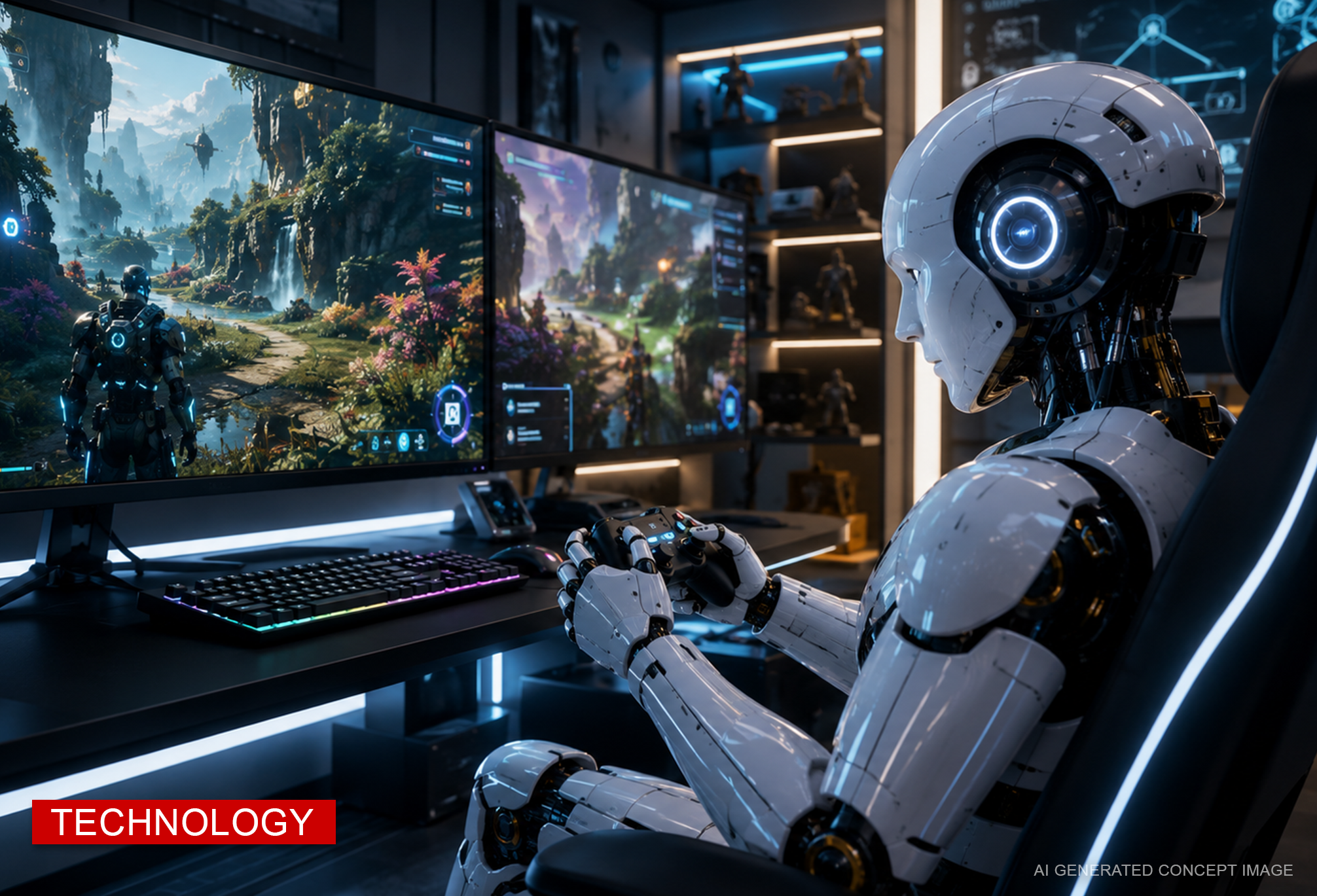
The future of AI robots may be shaped inside virtual worlds, where every movement, mistake, and reaction can become training data for real-world machines.
General Intuition, an AI startup linked with the gaming clip platform Medal, is building around that idea. The company recently raised $320 million at a $2.3 billion valuation, with investors betting that gameplay footage and player action data can help AI agents learn movement, space, timing, and cause and effect.
A game may look like entertainment to players, but AI researchers see it as a map of human decision-making. Every jump, turn, mistake, collision, and button press shows how a person reacts inside a moving digital world. That kind of data can teach an AI agent basic lessons, such as walls block movement, ladders can be climbed, objects have shape, and lighting changes what a player sees.
General Intuition is not trying to make robots better gamers just for fun. The bigger goal is AI that carries lessons from digital worlds into physical spaces. TechCrunch reported that the company showed an AI agent playing a Fortnite-like game while a four-legged robot explored an office nearby. The demo showed how one family of AI models could work across both a game and a real machine.
Many AI companies are now looking beyond chatbots. They want systems that can see, decide, move, and complete tasks in changing environments. Robots need more than commands for that. They need a stronger sense of how the world works around them.
Games and simulations help because they give AI a safe place for trial and error. A robot can fail thousands of times in a virtual room without breaking equipment, damaging property, or putting anyone at risk. Developers can change the lighting, move objects, add obstacles, or reset the scene almost instantly. That makes training faster and cheaper than relying only on real-world testing.
Google DeepMind has shown why virtual worlds are useful with SIMA 2, an AI agent powered by Gemini. SIMA 2 can follow instructions, reason through goals, and act inside 3D game-like environments. The point is not just winning a game. It is about helping AI understand tasks, plan steps, and respond when the environment changes.
NVIDIA is working from a similar direction with Isaac Sim, a robotics simulation platform used for robot testing and synthetic data. Instead of placing a robot directly inside a warehouse, developers can first build a digital version of that space and see how the robot handles movement, sensors, people, carts, and obstacles.
Google DeepMind’s RT-2 also shows how robot training is changing. RT-2 learns from web data and robotics data, then uses that knowledge to turn vision and language into robot actions. In simple terms, the robot is not only memorizing one movement. It is learning how what it sees connects with what a person asks it to do.
Toyota Research Institute has taken another path by using generative AI to teach robots physical skills. TRI said its approach helped robots learn more than 60 dexterous behaviors, including pouring liquids, using tools, and handling soft or flexible items. That could lead to robots that learn by watching and practicing, instead of relying on engineers to program every movement manually.
The challenge is that games are not the real world. A game has rules controlled by software. Real spaces have uneven floors, bad lighting, friction, weight, weather, loose cables, moving people, and objects that behave differently each time. That gap between simulation and reality remains one of the hardest problems in robotics.
Still, the reason companies are chasing this idea is clear. Video games create huge amounts of interactive data, and robots need interactive data to improve. If AI can learn useful lessons from how humans play, move, react, and solve problems on screen, that data could help future robots move through the world with better judgment.







0 Comments