
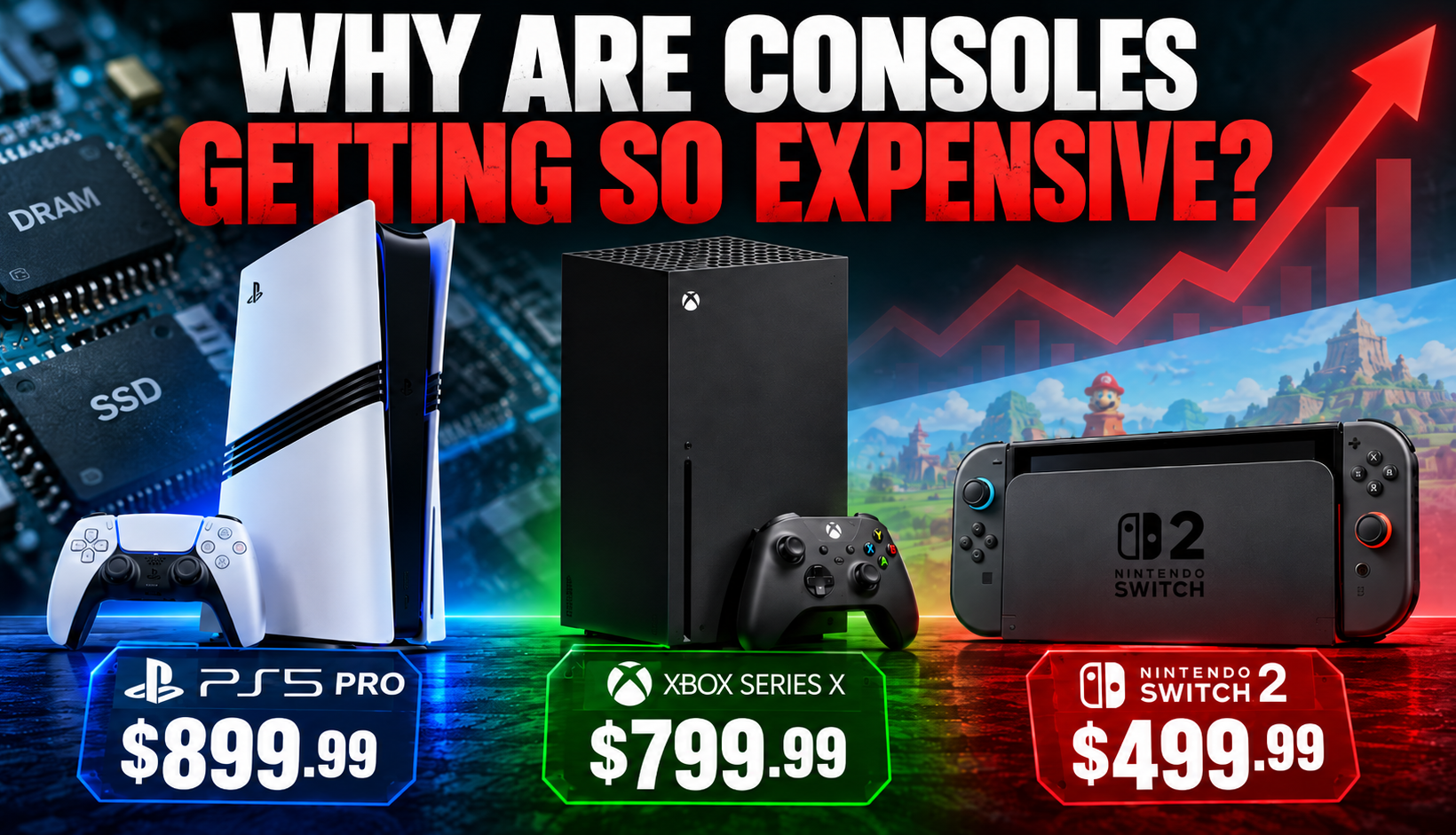
Buying a game console used to get cheaper the longer you waited, but today’s consoles have gone in the opposite direction.
Sony, Microsoft, and Nintendo have all raised hardware prices, leaving players paying more for systems that in some cases have been on the market for nearly six years.
Inflation explains part of the increase. According to the U.S. Bureau of Labor Statistics, consumer prices were about 29% higher in August 2026 than they were when the PS5 and Xbox Series X launched in 2020. That would put a $500 console from 2020 at roughly $643 today. Some console prices are now well above that, with manufacturers also facing higher memory, storage, tariff, and production costs.
The PlayStation 5 launched in 2020 at $499.99 with a disc drive and $399.99 for the Digital Edition. Sony raised its U.S. prices in April 2026 to $649.99 for the standard PS5 and $599.99 for the Digital Edition. The PS5 Pro now carries a suggested price of $899.99. Sony blamed continued global economic pressure for the 2026 price increase.
Xbox has climbed even faster.
The Xbox Series X launched at $499 in 2020, while the Series S started at $299. Microsoft now lists the 1TB disc model at $799.99. The Xbox Series S now starts at $499.99 for the 512GB model.
Microsoft has been unusually specific about why.
When it announced another round of price increases for August, Xbox said the cost of console storage and memory had increased by more than 2.5 times. The company expects those costs to keep climbing and said consoles typically sell for less than they cost to manufacture.
Nintendo has not escaped the increases either.
The Nintendo Switch 2 launched in June 2025 at $449.99. Nintendo raised the U.S. price to $499.99 on Sept. 1, 2026, citing changes in market conditions.
Memory is another reason console prices are climbing.
Game consoles rely heavily on DRAM and storage chips, and those components have become much more expensive. The rapid construction of AI data centers has created huge demand for memory, putting console makers in competition with some of the largest technology companies in the world for the same manufacturing capacity.
Reuters reported earlier this year that memory prices doubled during the first quarter, while Nintendo and Sony both warned investors about higher component costs. Nintendo said increased component prices and tariffs could add roughly 100 billion yen to its costs during the current financial year.
The problem is not something manufacturers can fix quickly by simply ordering more chips. Memory production is concentrated among a small number of companies, and adding new manufacturing capacity can take years.
That is especially painful for console companies because their hardware business has traditionally worked differently from phones or PCs. A company can keep the console price low, build a large player base, and then make money through games, subscriptions, accessories, and digital purchases.
High component prices make that harder.
Microsoft has already responded by expanding financing, refurbished-console sales, and trade-in programs alongside its price increases. Those programs may lower the upfront cost, but they do not change the fact that a 512GB Series S now costs the same amount that the Series X did when this console cycle began.
There is also a limit to how high prices can go before players simply decide to wait.
A $500 console was already a significant purchase for many households. Once consoles start reaching $650, $800, or $900 before adding games, extra storage, controllers, online memberships, or headsets, the price of getting into a new system starts looking very different.
The concern becomes even bigger when looking toward the next generation.
New PlayStation and Xbox hardware will eventually need faster processors, more memory, and more storage at a time when many of those components are becoming more expensive instead of cheaper.
Console gaming is still less expensive than many high-end gaming PC setups, but the gap is getting smaller.
The days of waiting a few years for a console to become cheaper may not be gone permanently, but with today’s consoles, waiting has often meant paying more.








0 Comments