
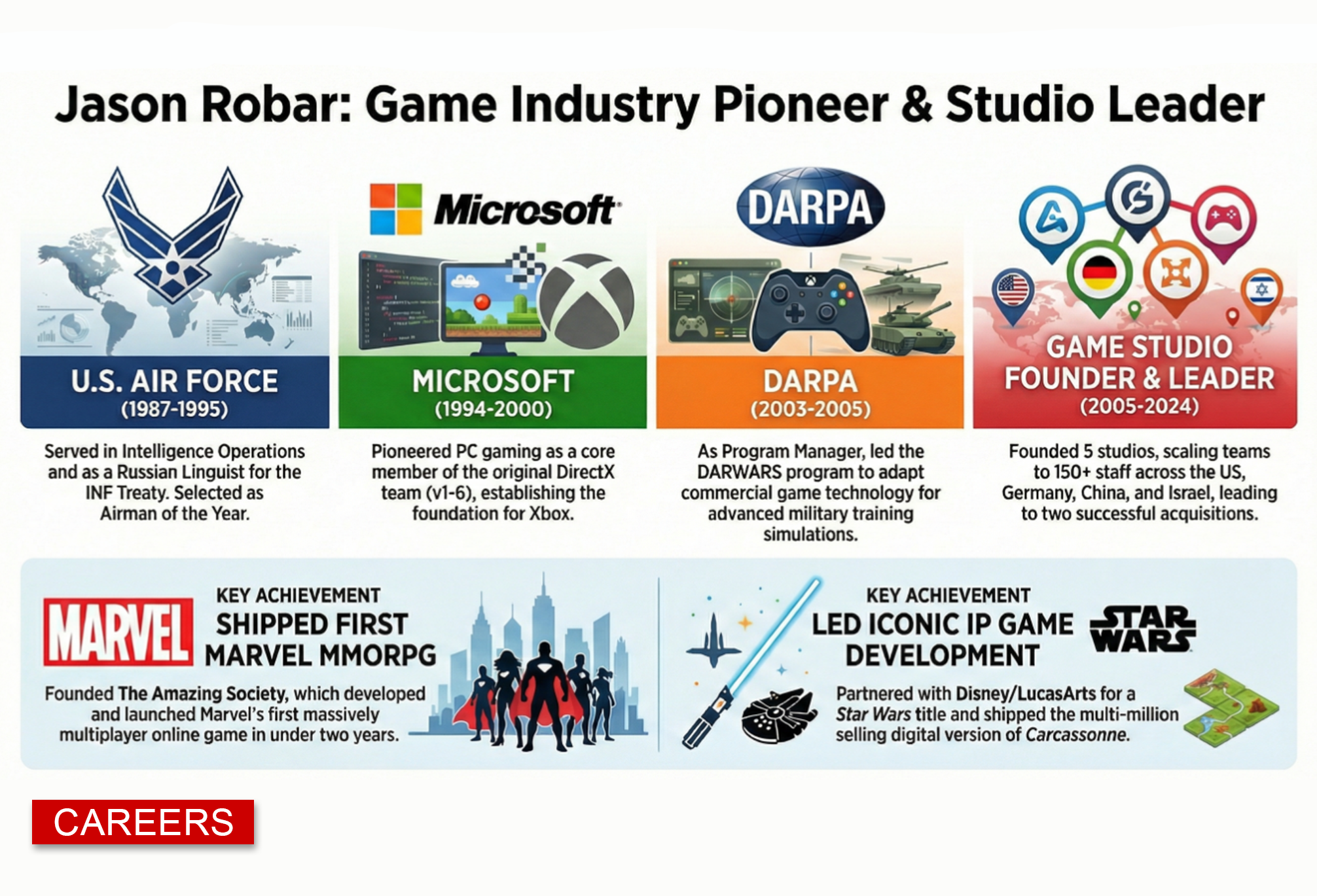
Jason Robar’s career has moved across military service, gaming, technology, defense innovation, and entrepreneurship.
But long before he worked at Microsoft, helped bring game technology into military training, or led studios around the world, Robar was a kid drawn to tabletop role-playing games, board games, and the way people come together around a shared experience. He first became a dungeon master in fifth or sixth grade, running games during recess instead of going outside.
“Tabletop RPGs and board gaming were definitely a core part of my life,” Robar said. “Gaming has been just in my DNA forever.”
Those early games helped shape how Robar thinks about leadership, teamwork, and decision-making. For him, games are not only about winning. They are about choices, consequences, and learning from what happens next.
“I think gaming gives you the chance to make mistakes and learn from those lessons,” Robar said. “You can lose and still play again.”
That idea has followed him through much of his career. Robar said games create opportunities for people to fail, adjust, and improve. They also teach players how to work with others who may see the same problem differently.
“Games give you the chance to fail and succeed and to learn from those things by understanding the impact of your choices,” he said. “The best games are really social experiences.”
Robar later joined the Air Force, serving on active duty and in the reserve. His military experience gave him another view of teamwork, one built around trust, responsibility, and a shared mission.
“The very first thing you get out of the military is this notion of we’re all in it together, what we call esprit de corps,” Robar said. “The experience of going through basic training with a bunch of strangers and coming out weeks later as a team, that’s hard to replicate in the private sector.”
He said the military’s ability to bring together people from different backgrounds and turn them into a functioning team became one of the most important lessons he carried into civilian life.
“That core idea of how to forge a team out of strangers is something that really helps in everything else from then on,” he said.
After leaving the military, Robar moved into technology and joined Microsoft, working several years on a project called DirectX.
At the time, Microsoft was not yet known as a major gaming company. Robar said the work helped open a new direction for the company as gaming became a larger part of the consumer technology market.
“The Xbox was not even a whisper of an idea,” he said. “And so I was part of the team that helped create DirectX, which became the X of Xbox.”
The experience taught him how technology can bring companies, developers, and markets together around a new opportunity.
“The biggest thing that I learned with DirectX was bringing people together, understanding the needs of that market, and understanding the needs of the companies and the people in those companies that want to go after an opportunity,” Robar said.
Robar’s background in gaming and training later led him to work for DARPA, where he focused on bringing game technology into military training through a project called DARWARS.
“That helped me get the job at DARPA, which was to bring game technology over to military training,” Robar said.
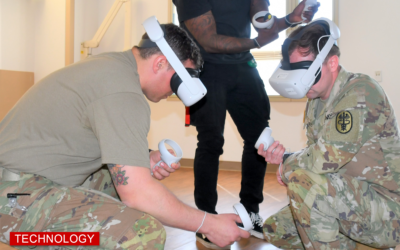
The idea was to use video game technology to help Service Members train more often, at lower cost, and in environments where mistakes could become lessons instead of real-world consequences.
“Games, as we talked about, give you the ability to lose and try again, to learn,” Robar said. “And so games are just a natural component of the training cycle.”
He said multiplayer games also teach communication, something that matters in both gaming and military operations.
“Most of what leads to success in multiplayer gaming is communication,” Robar said. “Learning how to be effective, quick, and understood by your teammates.”
After Microsoft and DARPA, Robar continued building a career in the gaming industry. He led studios in the United States, Germany, and Israel, including work with students through the University of Haifa and the creation of an RPG studio in Germany.
“I’ve been running multiple game studios around the world and different parts of the world, from Germany to Israel to the U.S., for many, many years,” Robar said. “So over 20 years. So I’ve had quite a different career.”
One of those studios was The Amazing Society in Seattle, where Robar worked on Marvel Super Hero Squad Online, a family-friendly massively multiplayer online game.
“It was so much fun to make a game that I could play with my kids,” Robar said.
The game included multiplayer action, a trading card system, and social spaces tied to a version of the Marvel universe built for younger players and families. Robar said working with characters such as Captain America, Hulk, Wolverine, and Iron Man required more than making them look right.
“When we make a character in a video game, not only does it have to look right, but it has to act right,” Robar said. “It has to feel right. It has to be authentic.”
Robar also worked on a Star Wars game that never launched. The free-to-play project was nearly ready for release before Electronic Arts acquired the exclusive Star Wars license.
“We were two weeks away from being able to bring this game out to the public as a free-to-play Star Wars game,” Robar said. “And most people have never heard of it nor seen it.”
While the project did not make it to players, Robar said the experience still mattered because of the work the team put into it.
“I just would have loved to have seen my team being able to see the fruits of their labor and put that in the hands of customers,” he said.
Robar is now applying many of those same lessons through Leaders Guild Labs, where he works to advise and coach software teams on building products, solving problems, and focusing on outcomes.
As part of that work, he also built World War 4 News, a project focused on helping people better understand modern conflict beyond traditional warfare, including cyber, information, economic, and technology-driven threats.
“World War 4 means there’s always something happening on one of these fronts,” Robar said. “Whether it’s what we typically think of as bombs and bullets, the military side of conflict is only one spectrum.”
Across those projects, Robar said the focus always comes back to the outcome. A project can have strong processes, checklists, and metrics, but those do not matter if the team loses sight of what it is trying to accomplish.
“In any product, any project, you’re trying to make sure you’re focused on the outcome, not just on measuring the work,” Robar said. “Am I achieving an outcome, not just doing the work?”
That lesson is also part of the advice he gives to Veterans looking to enter gaming, technology, or entrepreneurship. Robar said the first step is understanding who they are, what they want, and what they can build from their military experience.
“You are always the CEO of your own life,” he said. “No matter what career you choose or what you do with your life after the military, it’s understanding and assessing who you are now, where you want to go, and what outcome you want to get to.”
He said Veterans should look closely at the skills and values they gained in uniform, including teamwork, integrity, trust, and the ability to work through difficult situations.
“What can you take from what you’ve learned and who you are now, from your experiences with the military?” Robar said. “What can you turn that into? What can you build off of that?”
For Robar, military service gives Veterans a foundation that many people in business have never had. It teaches leadership, teamwork, and what it means to commit to something bigger than a paycheck.
“You come out of a space that’s difficult and stressful, that’s taught you about leadership and teamwork,” Robar said. “And it’s taught you about integrity and principles.”
That experience, he said, can become one of a Veteran’s strongest assets when they learn how to carry it into the next part of their life.
“You have a background and an experience that’s so different and so valuable,” Robar said. “You just need to understand how to present that to others. And you can really get ahead of a lot of other people because of that value that you got out of that career and mindset that you’ve learned in the military.”





0 Comments